Generation 2 / Level
Foosball Stadium
Inside the level


The challenge
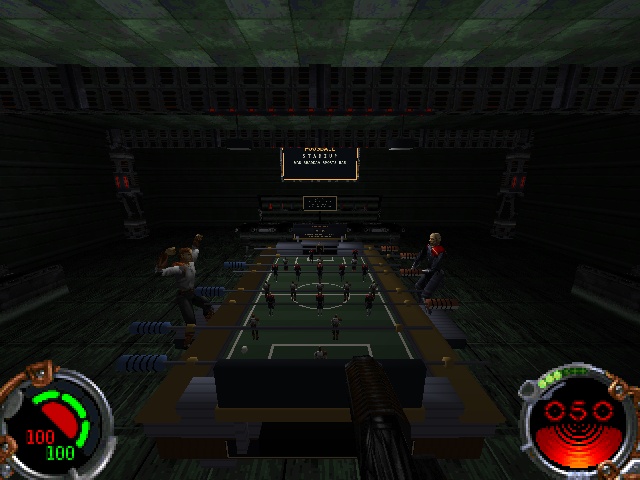
A Nar Shaddaa sports bar with a reusable 1v1 foosball table: Kyle versus Jerec in three-minute matches, with animated representatives and local voice announcements.
Can a reusable stock-JK class cog deliver responsive 1v1 foosball with bounded network traffic?
Research notes
A table that can become a mod object
The demonstration level places one table in a stock-textured sports bar. Its class COG owns the game, creates the rods, miniatures and scoreboards, and keeps state separately for up to eight tables. Leaving a side preserves the table and score.
A fixed-height ball simulation bounds every substep inside the rails and resolves goals and spinning feet on the host. Clients predict motion and recover from periodic absolute snapshots. The owner's restore guard rebuilds the local heap and children after a single-player load.
Animated teams and local sound
A larger Kyle or Jerec stands at each occupied side, follows its selected handle, shoves or yanks during actions, and cheers after scoring. Four measured handle poses per team, action keys and a cheer use the stock character rigs. Your own representative is hidden in first person and visible in third person.
Three-minute matches use the requested retail voice bank for hits, denials, scoring, remaining time, two lead-update opportunities and results. Separate Gold, Red and announcer queues prevent a character from speaking twice at once. Goal and ending effects precede responses. The 38 selected WAVs use 22050 Hz mono 16-bit PCM; final spoken digits fit below .90 seconds.
Stock resources and contrasting light
Each side uses one character throughout its rows and goal: scaled stock Kyle versus Jerec. The room shell was authored through a leased SED bridge; stock Nar Shaddaa materials and procedural signs supply the bar. Bar and dining furniture use stock Kyle as a scale reference, while the foosball rig keeps its original dimensions.
All new textures cost $0 of the authorized $3 budget. Two native point lights shape the models against lower room lighting. Long-lived local emitters retain their fractional power on joining clients; one heapless local lighting COG recreates them after saved-game loads. The static checker budgets eight tables and their local children at 432 of retail JK's 640 thing slots.
What this build taught us
Build 10 releases both players automatically when the three-minute match ends. A complete native 180-second run verifies exact appearance restoration, real walking, preserved final scores and completed winner audio on both peers. The table stays idle until two fresh USE joins start another 3, 2, 1 countdown. Build 9 established the twelve-check baseline for controls, physics, animation, lighting and saved-game recovery. Both owners' A/D and W/S inputs drive actual custom KEY tracks and visible arms. The 38 requested stock cues use separate local Gold, Red and announcer queues with checked FX-before-speech ordering. Matching three-peer on/off captures verify the dynamic lights; a local repair restores emitters after saved-game loads. Steady traffic is 16.83 packets per second per recipient; budget 432/640 things; art $0. The owner accepted human gameplay; retail verification remains outstanding.
Get this build
- Follow the instructions included with the download.