
Generation 2 / Research
Space Scrap
Inside the research


The challenge
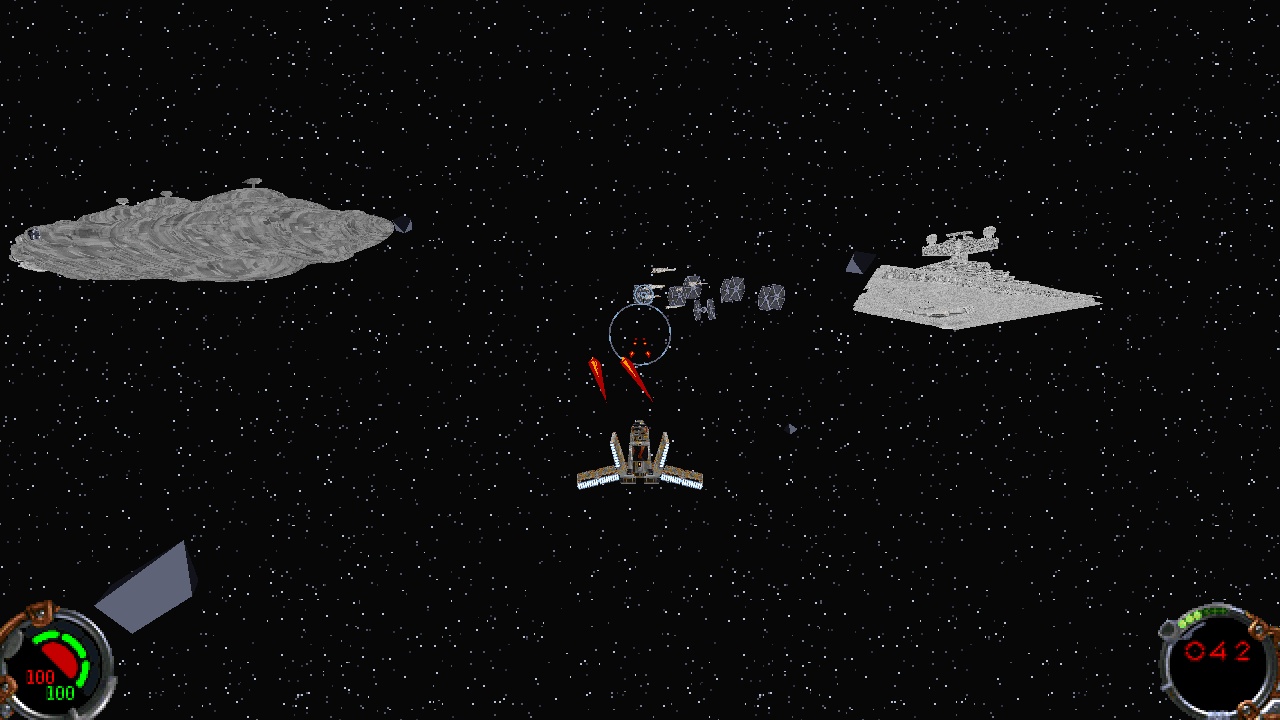
Kyle-height starfighters and oversized lasers in a continuous Rebel/Imperial battle, with X-wings, TIEs, Home One and a Star Destroyer.
Can Kyle-height starfighters with oversized lasers make compact space battles readable and satisfying?
Research notes
Small vehicles, readable weapons
The Crow is 0.196576 JK units long, close to Kyle's 0.18114-unit rest-pose height, in a 40-unit arena. Ships, scenery, linear movement, camera distances, audio ranges and AI spacing share one-eighth scale; lasers retain the full original size and hit radius.
The reference is Twisted Metal-style combat in Jedi Knight. This fork establishes the miniature flight scale first; multiplayer, land vehicles and larger populations remain later directions.
Two factions, continuous replacements
Six X-wings and six TIEs fight around the two capital ships. Fighters lead their shots and break away between passes. Each lost ship is replaced independently; losing the Crow leaves the wider battle running.
Home One and the Star Destroyer are stationary, indestructible gun platforms. X-wings use a 4,159-triangle fleet mesh; the Star Destroyer retains its full source topology. Multiplayer, critical systems and land vehicles remain later directions.
Research result and next cycle
Uniformly shrinking space, models, linear speeds, camera distances and sound ranges preserves the parent flight timing. Keeping laser geometry and collision large makes grazing shots count; actual fire-key checks hit with oversized bolts and miss with proportional bolts.
The twelve-fighter battle replaces waves with independently replenished factions. Both capital ships are stationary, indestructible firing platforms; their critical systems and hull collision are outside this prototype.
The next cycle will use these findings in a separate level or total conversion. The experiment remains a reference for flight feel, miniature scale, readable weapons and a battle that continues independently of the player.
What we learned
The owner accepted the miniature flight scale and submitted the experiment as research. At one-eighth scale, the Crow is approximately Kyle-height in length while the lasers keep their full size and hit radius. An autonomous 90-second battle recorded 16 TIE losses, 13 X-wing losses, 40 launches and 324 capital bolts without player firing. Eighteen automated checks verify faction targeting, individual replacements, friendly-fire suppression, hostile Crow damage, native save/load, flight, camera audio and ordinary packed player mode. Larger populations, retail compatibility, multiplayer and native player HUD integration remain unverified or unfinished.
How to play
Mouse or Left/Right: steer. Page Up/Page Down: pitch. Home or numpad 5: center the pitch stick.
W/S: throttle. A/D: roll. Jump (normally X; Space also in the local launcher): boost. C: air brake.
Primary fire (mouse or Ctrl): twin red cannons. TIEs fire green bolts.
Prototype HUD: left red = hull, left green = boost reserve, right number = throttle percentage.
Release notes
One-eighth Flight Fight scale: the Crow is about Kyle's height in length, Home One is nine units long, and the arena is 40 units across. Lasers retain their full size and hit radius.
Fly with Rebel X-wings and Home One against TIEs and a Star Destroyer. Each side maintains up to six fighters through individual replacements; both capital ships fire but are indestructible. Multiplayer and land vehicles remain later work.
Credits
Fork of Flight Fight build 7, with generation 1 input-proxy and gen2 Shark Lab smoothing precedents. Flight/AI reference: SPACEDOG v2.
Crow, strifle bolts, stock sprites and Kyle comparison: Jedi Knight / LucasArts.
TIE fighter: owner's Star Wars Battlefront (2004) model and texture handoff.
Home One: owner's MC80A_Home One handoff; its source ReadMe credits AJD-262.
X-wing exterior: owner's Rogue Squadron II: Rogue Leader handoff, ripped by ITEACHVADER for Models Resource.
Star Destroyer: owner's handoff; source ReadMe credits AJD-262.
Independent fan research using Jedi Knight and credited Star Wars game artwork; not made or endorsed by Lucasfilm or Disney.
Code, tests and research writing were developed with AI assistance. Ship artwork comes from the credited game assets.