
Generation 2 / Research
Flight Fight
Inside the research


The challenge
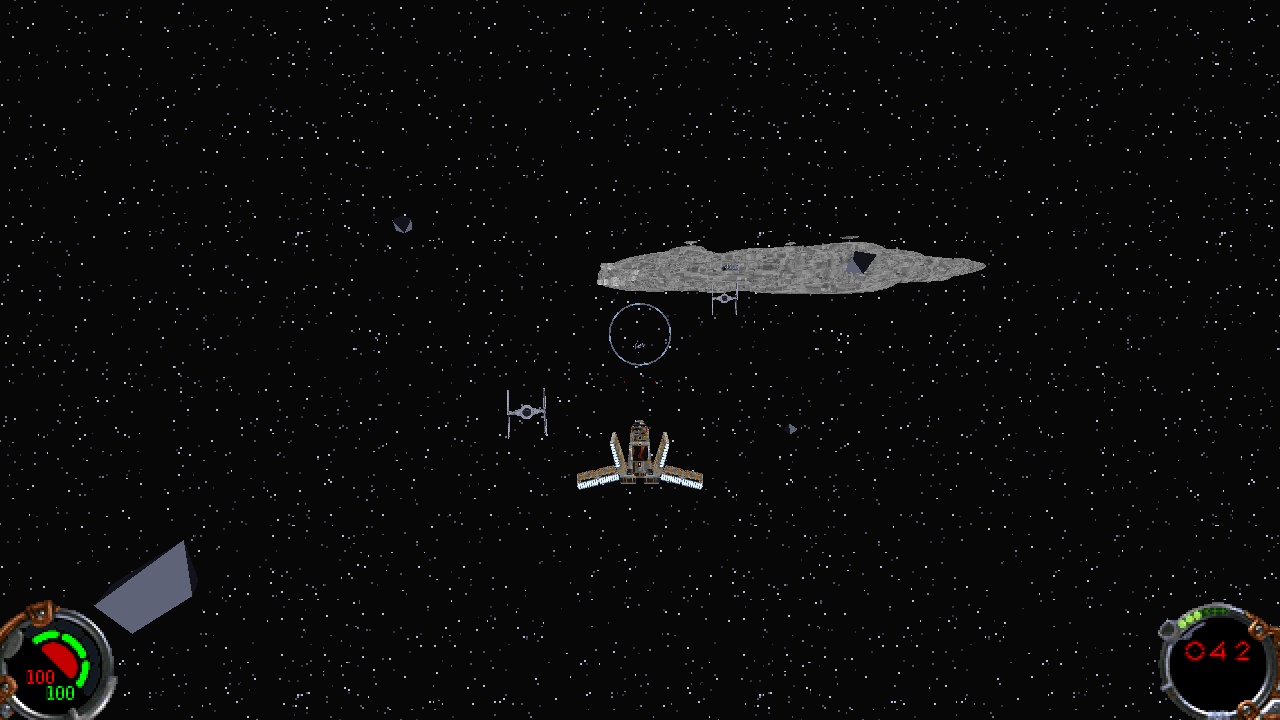
Pilot the Moldy Crow against TIE fighter waves near Home One, with red cannons, green enemy shots and a smooth chase camera.
Can the Moldy Crow feel responsive and satisfying in a smooth single-player dogfight against TIE fighters?
Research notes
The question is flight feel
Throttle, banking, boost, braking, pitch-stick deflection and camera lag are the first tuning surface. TIEs chase, fire with partial lead, break away, avoid one another and return to the combat area. Waves grow from three fighters to a six-fighter cap.
This experiment deliberately concentrates on single-player quality. A future TC will have another name, and multiplayer belongs to a later experiment.
Camera audio and isolated input
The input player occupies a disconnected capture sector while the Crow and camera fly elsewhere. A native mixer test produces an audible signal for a source near the camera and silence for one near the remote player. This removes the need for proxy sound-emitter objects in the capture room.
The space walls use the 0x200 sky flag. The stock Moldy Crow and strifle bolts combine with the supplied TIE and Home One models; red and green bolts share geometry.
What carries forward
This experiment establishes full-scale flight feel and camera-relative sound. Space Scrap forks the same flight at one-eighth scale to study compact battles and forgiving lasers.
Both experiments are submitted as research this cycle. The next cycle will turn Space Scrap into a separate level or total conversion, with its final scope and name chosen then. Multiplayer, native player HUD integration and retail verification remain follow-up work.
What we learned
The owner accepted the full-scale flight prototype as a useful research result. A remote input player, continuous physics and a smoothed chase camera support the Crow/TIE dogfight without engine changes. Native audio listens at the active camera even when the input player is 1,000 units away; cannon and explosion ranges must still match the world scale. Home One provides a 72-unit reference. Ten automated checks cover real controls, save/load, actual projectile combat, camera audio and the packed ordinary player mode. Native player ammo, health and shields remain unfinished, and retail compatibility is unverified.
How to play
Mouse or Left/Right: steer. Page Up/Page Down: pitch. Home or numpad 5: center pitch stick.
W/S: raise/lower throttle. A/D: roll. Jump (normally X; Space also in the local launcher): boost. C: air brake.
Primary fire (left mouse or Ctrl): twin red cannons. TIEs fire green bolts.
HUD: left red = hull, left green = boost reserve, right number = throttle percent.
Release notes
Custom flight controls; use the stock single-player game type. A deflected pitch stick keeps turning the ship. Center it to hold the current heading.
Home One is stationary scenery without combat systems. The prototype restarts the current wave when the Crow is lost. The owner accepted the flight result; native player HUD integration, multiplayer and retail compatibility remain follow-up work.
Credits
Moldy Crow and strifle-bolt assets: Jedi Knight / LucasArts.
TIE fighter model and texture: owner's Star Wars Battlefront (2004) handoff.
Home One model and textures: owner's MC80A_Home One handoff; source ReadMe credits AJD-262.
Flight and AI tuning reference: SPACEDOG v2; movement precedents: the gen1 remote-control prototype and gen2 Shark Lab.
Independent fan research using Jedi Knight and credited Star Wars game artwork; not made or endorsed by Lucasfilm or Disney.
Code, tests and research writing were developed with AI assistance. Ship artwork comes from the credited game assets.