
Generation 2 / Mod
Shark Lab
Inside the mod


The challenge
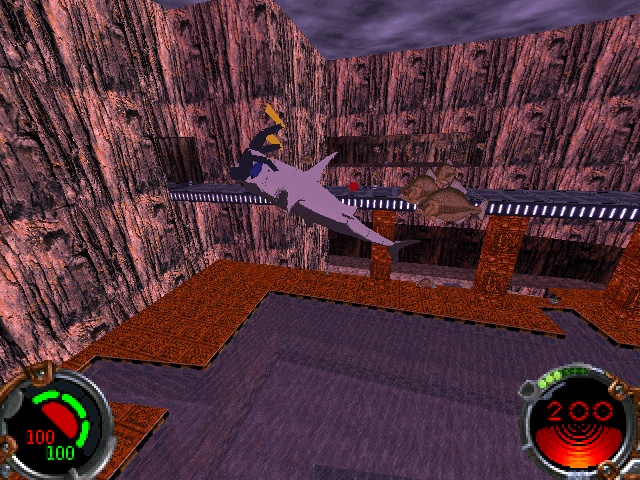
Rigged boss sharks and 32 killer piranhas in fully flooded Canyon Oasis, with articulated jaws, paired victim animations and a smooth shark-follow camera.
Can two enemy synchronization policies support predators in flooded 3D Oasis?
Research notes
Spend synchronization where it matters
The experiment separates nearby underling death sharing from host-owned boss health, targets and combat states. Local presentation follows sparse logical updates, avoiding a transform-packet channel for every underling.
This trades exact underling agreement for a looser shared encounter. It is not a claim of identical simulation on every peer, and host migration is not implemented.
Routes must produce physical movement
The three-dimensional routing checks inspect clearance and actual travel through sectors and changes in elevation. Frozen velocities form a negative control: a valid route calculation alone does not prove that the creature can move along it.
Reported timing samples include both engines, rendering and harness overhead. They are local measurements for the tested population, not retail frame-rate guarantees or evidence of larger-scale performance.
Presentation has its own failure modes
Rigged sharks, articulated piranhas and paired victim animations are checked in the engine as well as through hierarchy and keyframe validation. The shark teeth were adjusted after detached-looking bases were noticed in the initial preview.
Grabs temporarily change victim visibility, animation and camera focus. Release, rescue, death, respawn and native saves need to restore a usable player and camera, so those transitions are tested alongside the combat behavior.
What remains to be learned
The current scope is Canyon Oasis, two bosses and a finite 32-life underling cohort. Human combat feel, camera behavior near walls and retail compatibility remain open. Nonstandard player hierarchies require matching victim animation keys.
What this build taught us
The owner's piranha now replaces every underling sphere: eight rigid joints, six clips, attached original teeth and separate living/dead skins. Shared local presentation preserves sparse steering and loose multiplayer deaths. Fourteen automated checks cover the rigs, visible animations, corpse flight, boss rallies, equipment, multiplayer recovery and native saves. Human feel and retail compatibility remain to be tested.
Get this build
- Put SHARKLAB.GOB in mods and enable it on every peer, by itself.
- Bind Mod Menu in Setup > Controls, then host Canyon Oasis.
- The map is always flooded. Scuba starts ON; gaze and press the menu key to change it.
How to play
Bind Mod Menu in Setup > Controls, then press the bound key to open it.
Look at a button and press the menu key again to select Scuba ON/OFF or Close.
Shoot a boss that has grabbed another player to make it release them and switch targets.
Release notes
Run SHARKLAB.GOB by itself on every player and host Canyon Oasis. No stock level is distributed.
The map stays flooded and Scuba starts on. Each life starts with a stormtrooper rifle and 200 energy cells.
Underling deaths are shared by proximity; boss health, targets and combat states are host-owned. Host migration is not implemented.
Only Canyon Oasis is supported. Automated OpenJKDF2 checks do not certify retail Jedi Knight.
Credits
Scuba suit and breathing sound: the generation-1 Scuba experiment, with attribution to Gnarly / Club OC. Five suit materials are inherited flat-color placeholders.
Mod Menu, navigation, enemy controllers and drifting blood: COG Factory.
Boss shark and piranha source models: supplied by the owner. The piranha keeps its original teeth and texture.
Rigid sections, jaws, animations, living and dead caps, victim presentation and follow camera: Shark Lab tooling.
Physics-follow technique: SM Sith Lord's archived manipulator camera and weapon.
Canyon Oasis and Jedi Knight: LucasArts. No stock level or game archive is distributed.